

Key takeaways
- Data sovereignty extends beyond physical server locations, requiring customer-controlled encryption keys to prevent foreign court warrants from exposing sensitive cloud data.
- Changing global regulations now demand technical proof over simple contracts, making built-in audit logging and granular access controls non-negotiable for cloud databases.
- MariaDB eliminates vendor lock-in and legal exposure by providing an open, flexible platform that lets you deploy and secure data anywhere without expensive custom re-engineering.
Every organization now operates in a world where data doesn’t just need to be secure – it needs to be sovereign. Where it’s stored, who can access it, which laws govern it, and whether a foreign government can compel its disclosure are no longer legal footnotes. They’re board-level risks, procurement requirements, and increasingly, deciding factors in which database a regulated business is even allowed to use.
If you’re evaluating database and cloud infrastructure for a bank, insurer, healthcare provider, government agency, or any multinational handling personal data, data sovereignty isn’t a compliance checkbox anymore. It’s an architectural decision.
What Is Data Sovereignty and How Does It Differ From Data Residency?
The term gets used loosely, so it’s worth being precise. Three related but distinct concepts drive most requirements organizations encounter:
- Data residency – data is physically stored in a specific geographic location.
- Data localization – a legal requirement that certain data must stay within a jurisdiction’s borders, often with restrictions on transfer abroad.
- Data sovereignty – the broader principle that data is subject to the laws of the country in which it is collected or stored, regardless of where the company processing it is headquartered – including who can be legally compelled to hand it over, and under what authority.
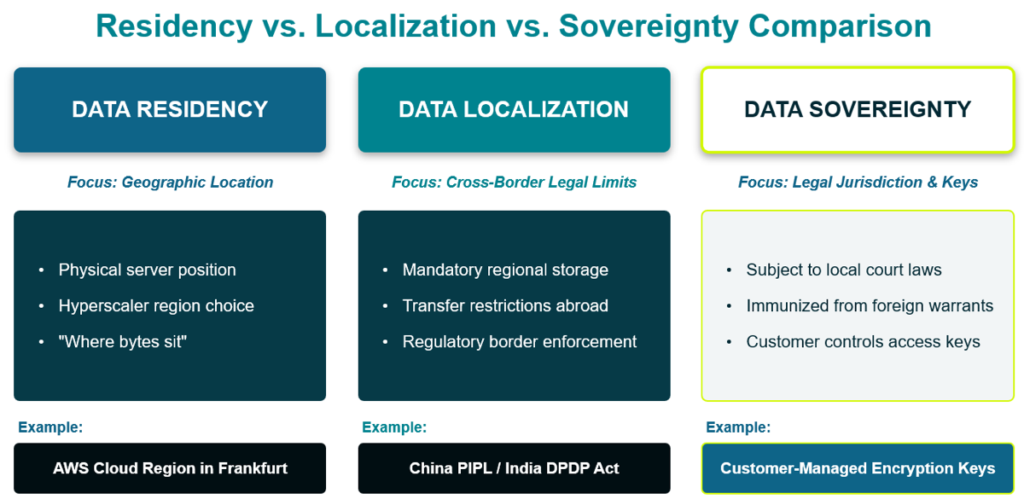
That last point is what makes sovereignty harder to engineer around than residency alone. A database sitting in a data center in Frankfurt or Mumbai doesn’t automatically make the data sovereign if the company operating that infrastructure can be compelled by a foreign court or intelligence statute to produce it. Sovereignty is as much about who controls access as it is about where the bytes sit.
Here’s what that looks like in practice. A European bank runs its core database on a US-headquartered cloud provider, with data physically stored in Frankfurt. A US court issues a CLOUD Act warrant demanding that data. Physical location in the EU doesn’t help – the provider is a US company, and US law claims reach over data it controls, wherever it sits. The provider is legally compelled to comply.
If the bank holds its own encryption keys, independent of the cloud provider, the outcome changes: the provider can hand over ciphertext, but it can’t hand over the ability to read it. That’s the gap between a legal and PR headache – and a genuine data breach.
What Global Regulations Are Driving Data Sovereignty Requirements for Databases?
Every major economy is now writing its own rules for cross-border data, and they don’t always agree with each other. A few of the developments shaping procurement decisions today:
Europe continues to set the pace. GDPR remains the reference point globally, but the mechanisms for transferring data out of the EU keep landing in court. The EU-US Data Privacy Framework – the successor to Safe Harbor and Privacy Shield, both of which were struck down by the European Courts – is currently facing an appeal at the Court of Justice of the EU, and a separate challenge questions whether the framework’s oversight body can still be considered sufficiently independent following a 2026 U.S. Supreme Court ruling. For any organization relying on that framework to move EU personal data to the US, the ground is shifting again – a reminder that betting compliance on a single legal mechanism is a fragile strategy.
Beyond the EU, sector-specific and cross-cutting rules are multiplying: DORA and NIS2 impose operational resilience and third-party risk requirements on EU financial services and critical infrastructure; China’s PIPL and Cybersecurity Law impose strict localization and transfer-approval requirements; and a growing list of countries – from Saudi Arabia to Indonesia to Nigeria – have adopted their own localization rules for specific data categories.
India’s Digital Personal Data Protection Act illustrates how fast this can move. The DPDP Rules were notified in November 2025, and key provisions – including cross-border transfer restrictions and data localization requirements for “Significant Data Fiduciaries” – are still being defined through subsequent government notification. Organizations operating in India can’t yet see the full shape of their obligations, but the direction – more scrutiny of where data goes and who touches it – is unmistakable.
In the US, sector rules (HIPAA, GLBA, CJIS, FedRAMP, state privacy laws) and the CLOUD Act’s extraterritorial reach continue to complicate life for any global vendor, especially in the eyes of non-US customers.
The pattern across all of this: regulators are converging on the same underlying question, even as their specific rules diverge – can you prove, technically and not just contractually, who can see this data and where it can go?
How Does Data Sovereignty Impact Cloud and Database Platform Selection?
For years, “compliance” meant picking a cloud region and signing a data processing agreement. That’s no longer sufficient on its own. Legal adequacy decisions can be overturned; localization rules can appear with little notice; a single global access-control policy doesn’t satisfy regulators who want jurisdiction-specific enforcement. Increasingly, organizations need infrastructure that can adapt to a regulatory map that keeps redrawing itself.
That shifts the conversation for anyone selecting a database platform. The questions worth asking now include:
- Deployment flexibility – Can the database run wherever the data must legally reside: on-premises, in a national or sovereign cloud, in a specific hyperscaler region, or across a hybrid mix – without re-architecting the application?
- Provable access control – Can you demonstrate, not just assert, exactly who and what can access specific data, down to the field level?
- Cryptographic control over data, not just infrastructure – Does encryption and key ownership stay in the customer’s or data owner’s control, independent of the infrastructure or cloud provider?
- Data protection that travels with the data – Can sensitive fields be masked, tokenized, or governed by policy consistently, whether the data is queried from head office or a regional subsidiary operating under different rules?
- Auditability – Can you produce a clear, exportable record of access and processing for a regulator, on demand?
- Transparency – Is the technology open enough to be independently verified, rather than a black box you have to take on faith?
Regulators have moved from trust-but-verify to verify-first. In the past, a signed data processing agreement was enough to close a deal. Today, regulators in the EU and India are asking for audit logs and key-management schematics – documentation that has to hold up under scrutiny, not just look good in a vendor questionnaire. Built-in audit logging isn’t an IT nicety anymore; it’s evidence a compliance team may need to produce in a courtroom.
A database that can only answer “yes” to some of these ends up forcing a difficult choice: build custom sovereignty controls at the application layer, or accept a compliance posture that a regulator – or your own legal team – might not sign off on. The first option is rarely as cheap as it sounds. We’ve seen organizations spend 18 months and millions of dollars building a bespoke “sovereignty layer” on top of an inflexible database, only to watch a new regulation render much of that work obsolete. The better outcome is a database flexible enough that you adapt with configuration, not a rewrite.
How Does MariaDB Architecture Support Data Sovereignty Requirements?
MariaDB’s architecture anticipated this shift. Because we aren’t tied to a single cloud provider’s infrastructure or legal domicile, organizations retain a degree of control that’s difficult to replicate on proprietary platforms:
- Deploy anywhere. Open-source foundations mean MariaDB runs identically on-premises, in private and sovereign clouds, across major hyperscalers, or in hybrid combinations – with no proprietary lock-in dictating where data must sit.
- Strong data protection controls. Encryption at rest and in transit, robust role- and privilege-based access control, and comprehensive audit logging are built into the platform, not bolted on.
- Open, verifiable technology. As open source, MariaDB’s code can be inspected, not just trusted – a meaningful advantage when regulators or security teams ask “how do we know?”
- No single point of jurisdictional exposure. No single cloud provider’s legal domicile determines how or where your databases – and by extension your data – are governed.
How Is MariaDB Evolving Its Platform for Future Sovereignty Compliance?
Regulatory pressure on data sovereignty isn’t leveling off – it’s accelerating, and the organizations that will handle it best are the ones building sovereignty into their data infrastructure now rather than retrofitting it under deadline.
We’re continuing to invest in this area, with a particular focus on giving customers in the most regulated industries – financial services, healthcare, government, and critical infrastructure – even finer-grained, provable control over exactly who can see what data, wherever it lives. We are also working on new integrations that will enable regulated organizations to enforce jurisdiction-aware controls and eliminate sensitive data exposure. We will share more information on the integration soon!
Want to talk to us about your data sovereignty requirements today? Contact our team.
PS: This page reflects the regulatory landscape as of publication. Data protection law is a fast-moving area – organizations should consult their own legal counsel for advice specific to their jurisdiction and industry.
Frequently Asked Questions
Data residency simply means that data is physically stored in a specific geographical location, whereas data localization is a legal requirement mandating that certain data must remain within a jurisdiction's borders with restrictions on export. Data sovereignty is a broader legal principle stating that stored data is subject to the laws and legal authority of the country where it is collected or located, regardless of where the operating company is headquartered. This distinction is crucial because physical storage alone does not protect data if operating entities can still be legally compelled by foreign courts or intelligence statutes, such as the U.S. CLOUD Act, to disclose information. True sovereignty requires complete control over access and encryption keys rather than relying strictly on the physical location of server hardware.
When an organization stores data on a foreign cloud provider, extraterritorial laws like the U.S. CLOUD Act can legally compel that provider to turn over user data regardless of where the physical data center resides. However, if the customer maintains cryptographic control and holds their own encryption keys independently of the cloud provider, the provider cannot decrypt the stored content. In response to a legal warrant or subpoena, the cloud vendor can only hand over unreadable ciphertext. Maintaining independent key ownership effectively prevents unauthorized data disclosure, transforming a severe data breach risk into a manageable legal proceeding.
Organizations choosing a database platform for data sovereignty must evaluate deployment flexibility to ensure the database can run on-premises, in sovereign clouds, or across multi-cloud environments without code rewrites. They must also verify that the platform offers provable, field-level access controls and cryptographic ownership where encryption keys remain under customer control. Additionally, the database should support data protection policies that travel with the data, such as field masking and tokenization, alongside comprehensive, exportable audit logs for regulatory proof. Finally, technical transparency is essential, as open-source solutions allow security teams and regulators to independently inspect and verify data handling controls.
Building a custom application-layer sovereignty control on top of an inflexible database is rarely cost-effective or sustainable. Organizations often spend millions of dollars and up to 18 months engineering custom sovereignty solutions only to find that rapid regulatory shifts quickly render those bespoke mechanisms obsolete. Global data privacy laws in regions like the EU and India are constantly evolving with short implementation timelines. Adopting a database platform with built-in deployment flexibility and native governance features allows organizations to adapt to changing legal requirements through simple configuration changes rather than expensive code rewrites.
MariaDB provides an open-source foundation that allows identical deployments on-premises, in private or sovereign clouds, across major cloud providers, or in hybrid configurations without vendor lock-in. Built-in platform capabilities include encryption at rest and in transit, granular role-based access controls, and detailed audit logging that can be produced directly for courtroom or regulatory verification. Because MariaDB is open-source, its code can be independently audited and verified by enterprise security teams seeking transparent proof of compliance. Furthermore, MariaDB avoids single-point jurisdictional exposure by ensuring that no single cloud provider's legal domicile dictates how customer database records are governed.
Regulators worldwide are tightening controls on cross-border data flows, led by European Union frameworks like GDPR, DORA, and NIS2 alongside evolving judicial challenges to the EU-US Data Privacy Framework. Concurrently, jurisdictions like India with its Digital Personal Data Protection (DPDP) Act rules and China with its PIPL are defining strict localization requirements for significant data fiduciaries. Other nations including Saudi Arabia, Indonesia, and Nigeria are introducing similar localized constraints on specific data categories, while U.S. statutes like HIPAA, GLBA, FedRAMP, and the CLOUD Act add further legal complexity. Because regulatory frameworks continue to land in court or shift unpredictably, relying on a single contractual data transfer mechanism is fragile compared to building technical, provable enforcement into the database layer.
Modern global regulators have transitioned from a "trust-but-verify" model to a strict "verify-first" standard requiring concrete technical evidence. Instead of accepting signed vendor processing agreements, regulatory bodies in jurisdictions like the EU and India now demand detailed audit logs and key-management schematics. MariaDB features built-in, exportable audit logging directly inside the database platform to track data access and processing events on demand. Having native audit records gives enterprise legal and compliance teams verified, courtroom-ready evidence to prove exactly who accessed sensitive records and where data transfers occurred.
