


Datasheet
MariaDB GridGain
Distributed In-Memory Caching and Compute for Real-Time Data Processing and AI Agentic Apps
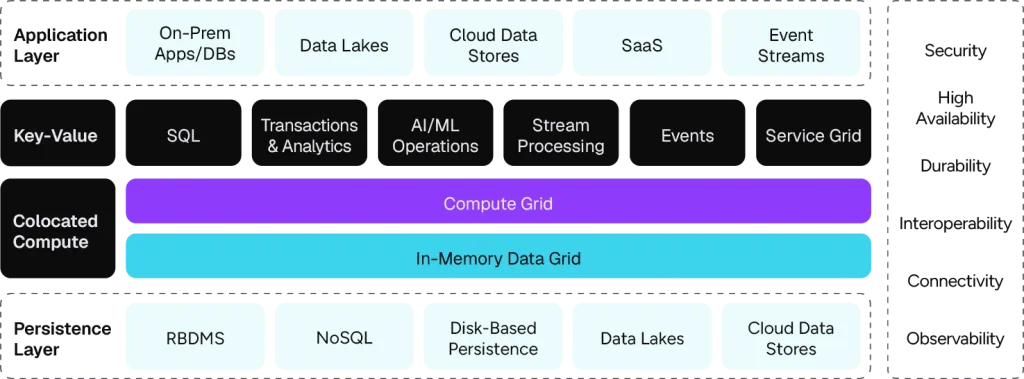
Extends the capabilities of the MariaDB Enterprise Platform with a native distributed caching and compute layer between your applications and systems of record. Hot data and read-intensive workloads move into a shared-nothing, horizontally scalable memory tier, delivering sub-millisecond response times, ANSI SQL, ACID guarantees and colocated compute. Built for AI/ML and agentic applications
- Distributed vector search for retrieval-augmented generation (RAG)
- Semantic caching and agent memory
- Fast feature serving
- Real-time Machine Learning (ML) model execution for decision-making and in-transaction analytics
01Architecture
Deploys as a peer-to-peer cluster of server nodes that partition data across cluster RAM, with configurable replicas. The shared-nothing design eliminates single points of failure. Adding nodes automatically rebalances data and scales throughput and capacity linearly to millions of transactions per second (TPS) and petabytes of data.
02Integration and Persistence
Applications connect through SQL (JDBC/ODBC) or native APIs. Read-through, write-through and write-behind caching keep data consistent with MariaDB or any other system of record. Native persistence stores the full dataset on disk and caches as much as RAM allows, so datasets can exceed memory and each node scales on disk. After a restart, the cluster serves data immediately from its own copy, with no reload from the source.
03Colocated Compute
Compute runs where the data lives. Colocated processing, continuous queries, and streaming ingest eliminate network round trips, so complex calculations run against live data in milliseconds rather than in overnight batch jobs.
04Where Customers Deploy It
- Application acceleration: Keep hot data in memory in front of the database so applications stay fast during traffic spikes.
- Application modernization: Speed up an existing application with an in-memory layer and no code rewrite, then migrate off legacy or proprietary databases such as Oracle and DB2 at your own pace.
- Digital integration hub – Consolidate and curate data from disparate systems of record into a single, real-time hub that joins across systems and delivers answers in milliseconds.
- Mainframe offload – Move high-volume reads and compute off the mainframe to cut MIPS and serve every digital channel, while the core remains the system of record.
- Real-time decisioning – Run business rules and ML models against live event streams to drive risk, fraud and pricing decisions at the moment of interaction.
- Agent memory – Hold state, checkpoints and cross-session facts for AI agents, so a run resumes after a restart and the next conversation starts informed.
05Key Benefits
- Ultra-low latency at massive scale, with sub-millisecond data access
- Distributed in-memory architecture delivers massively parallel processing and linear scale-out to millions of TPS
- Colocated compute that runs business logic where the data resides, reducing network data movement and disk I/O
- Stream processing and transactional analytics make decisions within the transaction window
- Data integrity and consistency through ACID compliance, read/write-through, and disk-based persistence
- Distributed SQL with full JOINs and aggregations to answer questions in memory
- Continuous availability across racks, data centers, and clouds
- Lower infrastructure spend by offloading non-core database operations and reducing mainframe MIPS
- One vendor and one support contract for the entire data delivery stack
Trusted by top 10 leaders
in banking, telco, and transportation
300x
faster risk calculations, 3 minutes to 600 ms at a global Top 5 bank
99.999%
availability sustained for 5+ years at a large telco solutions provider
200K
transactions per second at a national credit registry
06Expanding the Capabilities of the MariaDB Enterprise Platform
MariaDB GridGain brings distributed in-memory caching and computing natively into the MariaDB environment — not as a bolt-on, but as a deep integration built for mission-critical data.
- Sub-millisecond latency: Move hot data from disk to RAM and turn minute-long queries into millisecond responses.
- Frictionless implementation: Deploy as a transparent query cache in front of MariaDB with zero application code changes.
- Automatic data syncing: For read/write through/behind caching patterns, native MariaDB cachestore integration eliminates the need for custom application invalidation logic.
- Architectural consolidation: Replace third-party caching layers and fragile batch and ETL pipelines with one unified platform.
- Geo-distributed performance: Extend MariaDB’s reach with ultra-low latency across regions and data centers.
- Elastic scalability: Handle millions of requests by adding nodes, scaling performance as data and concurrent user traffic grow.
- Single operations view: Monitor MariaDB databases and GridGain clusters with Enterprise Manager.
- Unified enterprise support: One partner, one contract and one expert team for both the database and the cache.