

Key takeaways
- What it is: A unified enterprise data platform combining transactions, real-time analytics, in-memory speed, AI tooling, and multi-region scale on a single live data foundation.
- Key AI Capabilities: Features Agent Memory for durable state persistence across sessions, Semantic Cache to eliminate redundant model calls and reduce token costs, MariaDB AI Retrieval for unified document and operational data grounding, and AI Plugins for AI coding assistants.
- Performance Gains: Delivers 56% higher peak throughput than MariaDB 11.8 and runs 25% faster than MySQL 9.7.2 at peak performance.
- Enterprise Security & Scale: Offers Bring Your Own Cloud (BYOC) deployment, FIPS 140-3 compliance, and MariaDB Raft Cluster for multi-region active-active scalability without idle standby nodes.
Every enterprise is racing to put AI agents to work. But an agent is only as trustworthy as the data it acts on, and in most enterprises that data is scattered across databases, warehouses, vector stores and caches. Agents fire dozens of queries for every answer, and every hop between systems adds lag. When the data is stale, an agent doesn’t just slow down. It acts confidently on the wrong information.
That’s the problem we set out to solve. Meet MariaDB Enterprise Platform 2027, the best version of MariaDB we’ve ever built. It brings transactions, real-time analytics, in-memory speed, AI tooling and multi-region scale together on one durable foundation, with 56% more throughput than our last major release. Your applications, analytics and agents finally run on the same live data, wherever you choose to run it.
Here’s what’s inside.
AI Acceleration: faster to run, faster to build
Once an agent is live, every slow step and every repeated model call adds up, in latency and in tokens.
Applications follow a script: every query written, tested and tuned ahead of time. Agents are dynamic and unpredictable, writing each query at runtime, and hundreds of them may run at once, around the clock. To keep up, the data layer has to help agents keep track of long-running work and avoid paying twice for the same answer. Enterprise Platform 2027 keeps agents fast and affordable at runtime, and takes the plumbing out of building them.
Agent Memory gives agents a durable, in-memory store for their state, saved after every step and shared across agents and sessions. A long-running agent that pauses for human approval, or gets interrupted, picks up where it left off instead of starting over. It works with LangGraph out of the box, and other frameworks can use the same pattern.
Semantic Cache stops you paying twice for the same answer. Every question an agent sends to a model costs tokens, even one already answered in different words. Semantic Cache recognizes when a new question means the same thing as one already answered and returns the stored answer without calling the model. For applications where users ask similar questions, that means faster responses and lower token costs.
Faster to build. MariaDB AI Retrieval, in public preview on MariaDB Cloud, is one managed retrieval layer over both documents and live operational data. For documents, it handles parsing, chunking, embeddings and reranking. For data in MariaDB, it turns a natural-language question into a read-only SQL query against the live database, with follow-up questions that build on earlier context. Agents get grounded answers without a separate copy of the data in a warehouse or vector store, and without a second security perimeter to rebuild.
MariaDB AI Plugins round it out for developers, giving AI coding agents such as Claude Code and Codex built-in MariaDB know-how, so they write correct MariaDB code the first time. The plugins are open source and also work with OpenCode and Pi.
The division of labor is simple. Reasoning is the model’s job. Making sure what it reasons over is real and current is MariaDB’s.
A single source of truth: every workload on the same live data
Getting a current answer today often means hopping across separate systems. By the time the answer is assembled, it may already be stale: a price that changed an hour ago, an item marked available that already sold out. Enterprise Platform 2027 lets transactional, analytical, JSON and vector data share one platform, so every answer reflects what’s true right now.
MariaDB Exa is now generally available on premises, bringing real-time analytics to live operational data with no warehouse or ETL pipeline to maintain.
Faster vector search runs natively in the MariaDB core engine, with no separate vector database to manage. MariaDB Enterprise Server 12.3 delivers up to 30% more vector queries per second than version 11.8 at the same accuracy, with no schema or query changes.
MariaDB Enterprise Manager now brings the whole data tier, including the database, MaxScale and GridGain, into one observability console with single sign-on. Every component is run as part of the platform, not as a separate product.
Consolidating doesn’t mean settling. New capabilities inherit the reliability of the transactional core instead of being bolted on, so adding a workload doesn’t mean re-plumbing your foundation.
Scale without the rebuild
The dynamic, unpredictable behavior of agents doesn’t just change the queries a database receives. It changes how many. Enterprise Platform 2027 scales throughput and regions with that demand, without re-architecting your applications.
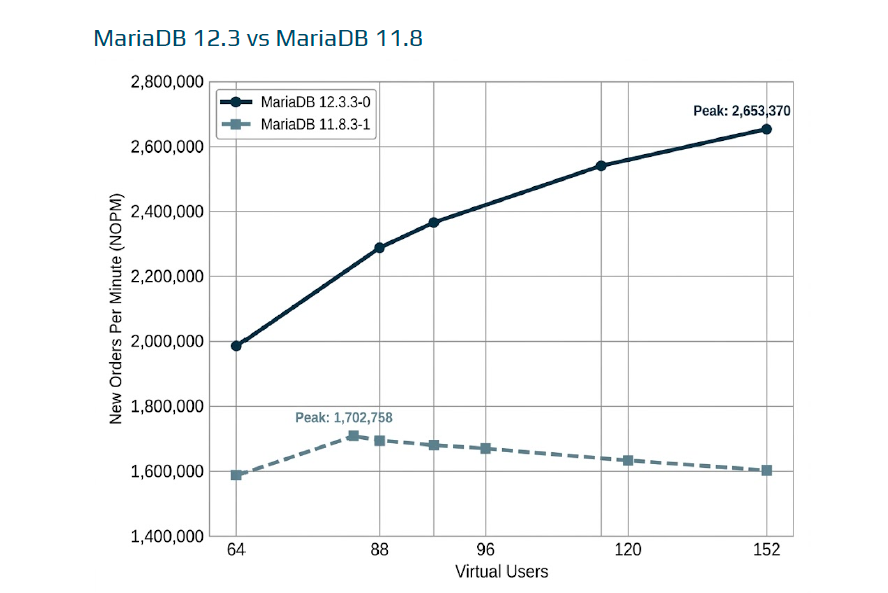
56% higher peak throughput. In third-party testing by McKnight Consulting Group on identical Google Cloud infrastructure, MariaDB Enterprise Server 12.3 delivered 56% more peak throughput than version 11.8.¹ It also runs 25% faster than MySQL 9.7.2 at peak performance.² With server memory prices climbing faster than budgets, getting more from the hardware you already run goes straight to the bottom line.
Multi-region without the trade-off. Running across regions has usually meant a hard choice: wait on the slowest, most distant node for every write, or pay for a second region that sits idle. This release removes both.
- MariaDB Raft Cluster, now generally available, keeps global applications fast and available. Writes commit as soon as a majority of nodes confirm, so one slow or distant node no longer sets the pace.
- Conflict detection and resolution puts every region to work. Each site can serve and update data for its local users, so standby regions no longer sit idle. When two sites change the same record, your own business rules settle it automatically, and replication keeps running without anyone stepping in to repair it.
The result: an agent in Helsinki and an agent in Singapore both get fast, current answers. Scaling means adding nodes, regions and workloads to the same platform, not rebuilding on a new one.
One trust boundary, wherever you run
When agents act on their own, no one checks each request. Picture a support agent pulling a customer’s history from two systems, each with its own access rules. If either is weaker, the agent can surface data the person asking was never cleared to see.
Enterprise Platform 2027 applies one set of access controls across transactional, analytical and vector data. An agent sees only what the person it works for is allowed to see.
Bring Your Own Cloud (BYOC), now generally available, runs the MariaDB Cloud data plane in your own AWS, Microsoft Azure or Google Cloud account. Your data and compute stay inside your trust boundary while MariaDB operates the database.
FIPS 140-3 is enabled through the MariaDB Enterprise Kubernetes Operator. It runs on NIST-validated cryptographic modules from Red Hat, helping federal and other regulated enterprises meet their cryptography requirements on the path toward FedRAMP High and DoD deployments.
It all runs on premises, in any cloud or on MariaDB Cloud, with the same security model everywhere. Choosing a cloud shouldn’t mean being locked into one.
And because the platform is built on curated open source, you get an open core you can inspect, with MariaDB accountable for every release.
Get started
MariaDB Enterprise Platform 2027 is generally available today. MariaDB AI Retrieval is available in public preview on MariaDB Cloud.
- Download MariaDB Enterprise Platform 2027
- Read the documentation
- Get the benchmark report: High-Concurrency TPC-C Benchmarking: MariaDB Enterprise Server 12.3 vs MariaDB Enterprise Server 11.8
Want to see it in action? Join our launch webinar, “Powering the Agent-Driven Enterprise: The Shift to a Unified Data Platform,” on November 18, 2026.
¹ McKnight Consulting Group, “High-Concurrency TPC-C Benchmarking: MariaDB Enterprise Server 12.3 vs MariaDB Enterprise Server 11.8” October 2026. HammerDB TPROC-C (derived from TPC-C, not an official TPC-C result), in-memory engine scalability test, MariaDB Enterprise Server 12.3.3-0 vs. 11.8.3-1 on Google Cloud. Sponsored by MariaDB. Full configuration in the published report.
² MariaDB Enterprise Server 12.3 vs. MySQL 9.7.2, peak performance. Full report at “High-Concurrency TPC-C Benchmarking: MariaDB Enterprise Server 12.3 vs MariaDB Enterprise Server 11.8“.
It's one platform for transactions, real-time analytics, in-memory speed, AI tooling and multi-region scale. Applications, analytics and AI agents all run on the same live data, on premises, in any cloud or on MariaDB Cloud.
Yes. Enterprise Platform 2027 is generally available today. MariaDB AI Retrieval is in public preview on MariaDB Cloud.
Agent Memory gives agents a durable store for their state, shared across steps, sessions and agents. Semantic Cache returns stored answers to questions already asked in different words, without calling the model again. AI Retrieval grounds agents in documents and live data, and AI Plugins help coding agents write correct MariaDB code.
In third-party testing by McKnight Consulting Group, MariaDB Enterprise Server 12.3 delivered 56% more peak throughput than version 11.8. It also runs 25% faster than MySQL 9.7.2 at peak performance, and delivers up to 30% more vector queries per second than 11.8 at the same accuracy. Read the full report: High-Concurrency TPC-C Benchmarking: MariaDB Enterprise Server 12.3 vs MariaDB Enterprise Server 11.8.
Yes. Bring Your Own Cloud, now generally available, runs the MariaDB Cloud data plane in your own AWS, Microsoft Azure or Google Cloud account, while MariaDB operates the database.
